Measurement recordCensus of a public frame
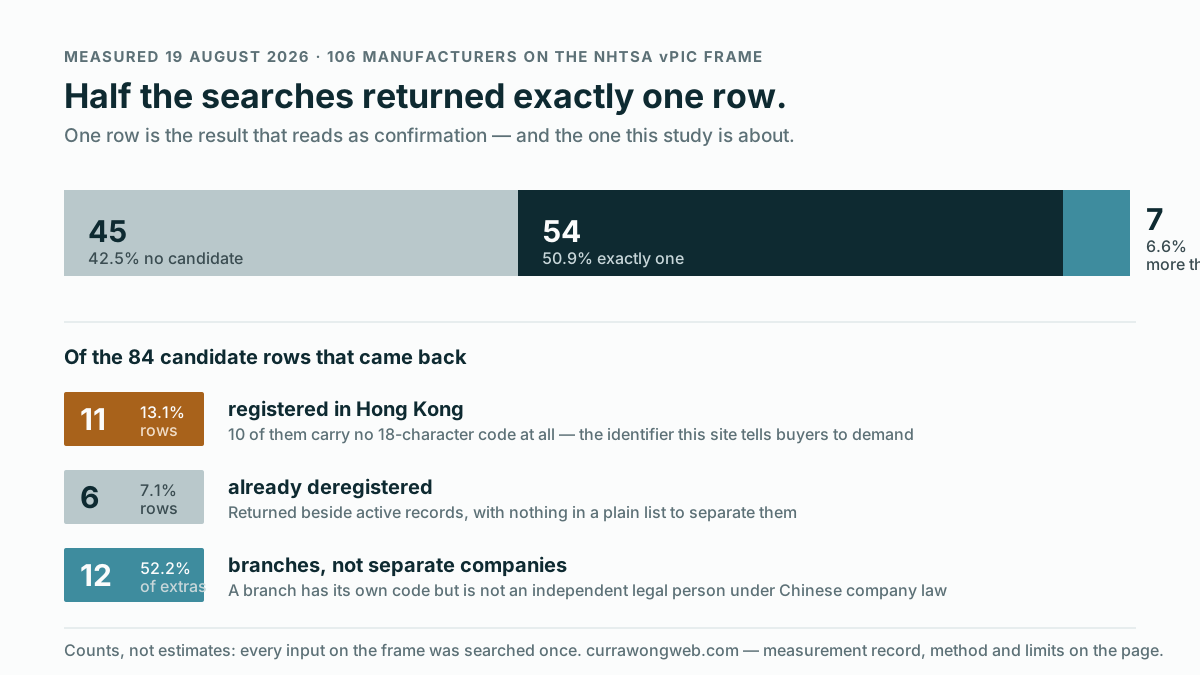
Half of these searches returned exactly one row. That is the dangerous outcome.
Every guide to checking a Chinese supplier starts the same way: get the exact Chinese registered name. A buyer holding a business card, an email signature or a storefront does not have it — that is why he is searching. So he searches the English name, and the screen returns one row. One row looks like an answer. We took a public list of 106 manufacturers that the US vehicle regulator records as Chinese, searched every one of them, and looked at what that row actually was.
1. The numbers
The frame is the 106 Chinese manufacturers registered with the US National Highway Traffic Safety Administration’s vPIC database — a list defined by someone else, published, and checkable, so the selection is not ours. Each was searched once by the registered English name NHTSA holds for it.
| Outcome of the search | Companies | Share |
|---|---|---|
| No candidate returned at all | 45 of 106 | 42.5% |
| Exactly one candidate returned | 54 of 106 | 50.9% |
| More than one candidate returned | 7 of 106 | 6.6% |
The middle row is the finding. A search that returns nothing is honest about its own failure — the buyer knows he has not found anything. A search that returns several rows at least shows him that a choice exists. A search that returns exactly one row shows him neither, and it is the most common outcome here.
2. What that one row can be
Across the whole frame the searches returned 84 candidate rows. Three things were in them that a plain list does not distinguish.
- A record in a different jurisdiction — 11 rows, 13.1%. These were registered in Hong Kong while the frame is a list of Chinese manufacturers. Four of them are worth stating plainly: inputs naming Qingdao and Shandong returned records written in traditional characters and registered in Hong Kong. Ten of the eleven carried no 18-character code at all, and the eleventh carried an eight-digit number. That is not an error in the record: Hong Kong entities are identified by an eight-digit Business Registration Number, adopted as the Unique Business Identifier on 27 December 2023, and not by the mainland’s 18-character Unified Social Credit Code. Every method this site teaches — the check-character test, a GSXT lookup — is built on that 18-character code and simply does not apply to them.
- A record that is already deregistered — 6 rows, 7.1%. They came back beside active records. In a plain result list nothing separates them; the status is a field you have to read.
- A branch rather than a separate company — 12 of the 23 rows beyond the first, 52.2%. Their Chinese registered names begin with the first row’s name and end in 分公司. One input returned three rows that were one company and two of its branches. Each branch has its own registration record and its own code, so each can be “verified” on its own terms. Which of them your contract, invoice and payment instruction name is a separate question, and the search screen does not answer it.
None of this makes the row wrong. It makes the row insufficient: it matched the string you typed, which is a different claim from being the party on the other end of your order. The practical consequence is narrow and cheap — before treating a single row as your supplier, confirm it against a second identifier that only the real party would hold, which in practice means the 18-character code printed on the business licence, and check that the name on the payment instruction is that same registered name, character for character.
3. Method, and what this study cannot say
- Frame: all 106 Chinese manufacturers in NHTSA’s vPIC trailer/vehicle set, the same frame as our earlier English-name lookup study, so the two are directly comparable. Census, not a sample: every entry was searched.
- Query: one search per input, by the registered English name, run from a mainland egress through a licensed Chinese business-information platform. Rows are recorded in the order the upstream returned them, before any ranking of our own — what this site does with the order afterwards is our product, not a fact about the world, and measuring it would only be measuring ourselves.
- No paid detail record was retrieved. That is deliberate: the question is what the buyer sees on the screen where he makes his choice, and he makes it before paying for anything. It is also a limit — the search layer does not return the English name held on each registration record, so this study cannot say how many of the single rows were in fact the right company. It says what the row is not sufficient to establish.
- Branch classification is deterministic, not a judgement call: a Chinese branch registration name contains 分公司. The jurisdiction test is the registered province field as returned. The place-name test covers only the 43 single-candidate inputs that carry a recognised province or city word; 4 of those 43 (9.3%) returned a jurisdiction that contradicts the place in the input, and all four were Hong Kong.
- A hypothesis that failed, reported as such. This study was designed to test whether search results are crowded by affiliated non-producing entities — investment, holding, supply-chain, consultancy, laboratory. The observation that prompted it came from one large industrial group. On this frame it did not reproduce: zero of the 23 additional rows carried that wording. The finding above is what the data supported instead.
- Scope limits: one industry (trailers and vehicles), one platform, one day, one query per input. Return rates differ by sector and by how a name was romanised. Nothing here is a statement about any named company, and nothing here is legal advice.
Citing this study
You are welcome to quote or reproduce these figures, including commercially, provided the measurement date, the frame and the stated limits travel with them. Machine-readable evidence: the summary metrics and the per-input raw records, including every candidate row in the order it was returned. Primary sources: NHTSA vPIC (frame; retrieved 9 August 2026), GB 32100-2015 (the 18-character code standard; checked 18 August 2026), Hong Kong FSTB on the eight-digit identifier and the government’s UBI explainer (both checked 18 August 2026), and GSXT, the official registry. More measured data: the research index.